The alarm goes at 5:15. By 5:40 you are in a wooden canoe, pushing into the papyrus channels of Mabamba Wetland on the northern shore of Lake Victoria, forty minutes from Entebbe. The sky is not yet light. Your guide paddles without speaking. The only sounds are the hull against the papyrus stalks, and somewhere ahead, unseen birds beginning to wake.
Mabamba Wetland is one of Africa's most important sites for the shoebill stork. About 11 individuals live across a marsh of some 16,000 hectares. Finding them requires patience, local knowledge, and a willingness to sit motionless in a canoe for extended periods while time moves differently than it does anywhere else.
The bird itself
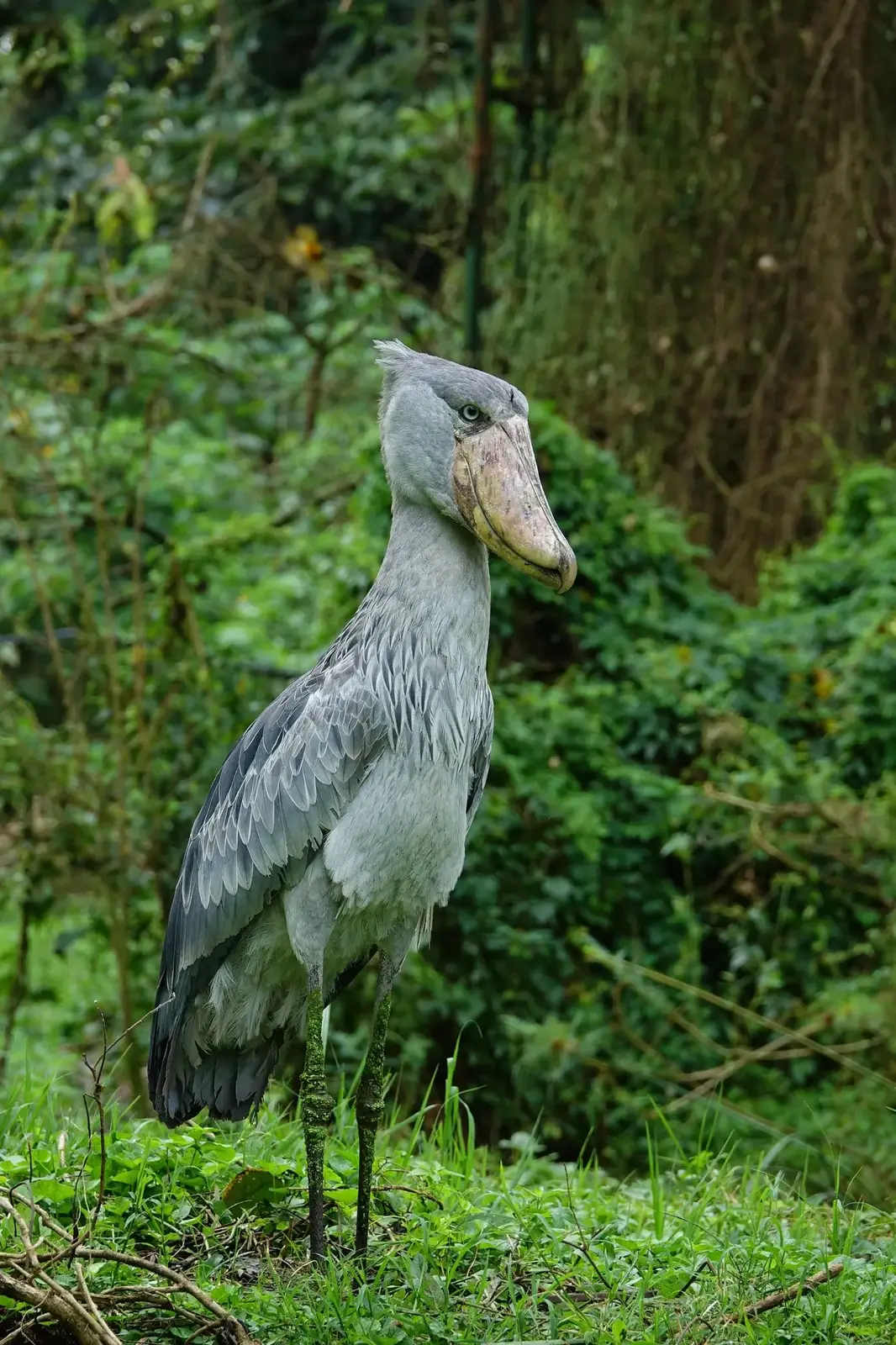
Balaeniceps rex. King of the whale headed birds. The shoebill stands up to 1.5 metres tall with a wingspan approaching 2.5 metres. Its bill is enormous, hook tipped and capable of producing a machine gun rattling sound used in social display. It is a grey bird in a grey marsh at grey dawn, which means you can be four metres from one before you see it.
The shoebill was there when I looked up from checking my camera settings. It had been there, perfectly still, for an unknown period. It was looking directly at me with one enormous amber eye. It did not move when I saw it. It was waiting for me to catch up.
Behaviour in the field
Shoebills hunt by standing motionless in shallow water, waiting for lungfish to surface. When one does, the strike is a violent lunge. Bill and body and wings combine in a movement called a collapsing. The entire bird falls forward onto its prey. It is not elegant. It is spectacularly effective.
On still mornings, and Mabamba has plenty of them, a shoebill will hunt for two to three hours in a single location without moving more than a few metres. This is extraordinary for a bird of its size, and it is what makes the Mabamba experience so intimate. You do not chase the shoebill. You find it, and then you wait, and if you are patient enough, it shows you things.
When to go
Year round, but best October through January when water levels are lower and birds more concentrated. Go at dawn. Always. By 9am the light is harsh and the birds have moved to shade. The canoe trip takes three to four hours for a proper encounter.
Written by
Vincent Arihoruhanga
Founder, Bwindi House Gorilla Safaris.